


Middle East War Day 3: Iran Attacks Saudi Aramco Refinery; Massive Explosions Reported in UAE, Qatar, and Bahrain
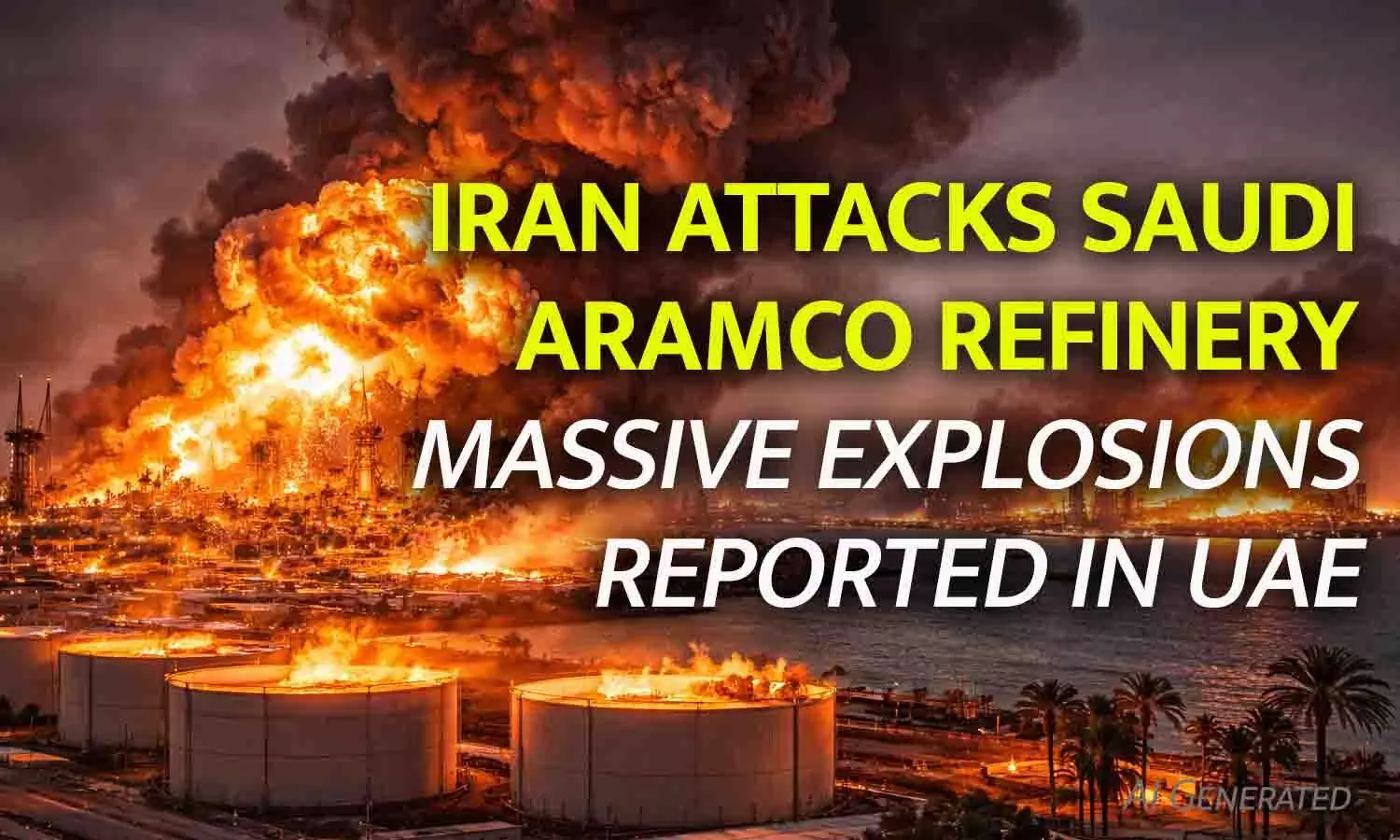


Iran Targets Global Energy Lifeline as Regional War Intensifies
The Israel–US vs Iran war has taken a dramatic and economically significant turn after Iran reportedly struck Saudi Arabia’s key oil facility at Ras Tanura. The refinery belongs to Saudi Aramco, widely regarded as the world’s largest oil-producing company.
According to international wire agencies including Reuters, operations at the Ras Tanura refinery were halted following the strike. If confirmed, this marks one of the most consequential energy infrastructure attacks in recent Middle East history.
The conflict, now in its third day, is no longer confined to direct exchanges between Israel and Iran. It has expanded into a multi-front regional confrontation involving Gulf states and non-state armed groups.
Why Ras Tanura Matters to the World
Ras Tanura is not just another refinery. It is one of the most critical oil processing and export hubs globally. The facility’s refining capacity is estimated at approximately 550,000 to 600,000 barrels per day.
More importantly, the Ras Tanura offshore oil loading terminal is among the largest in the world. From this strategic location, supertankers transport crude oil to markets in the United States, Europe, and Asia.
Energy analysts warn that prolonged disruption at Ras Tanura could:
- Trigger a sharp spike in global crude oil prices
- Disrupt supply chains already strained by geopolitical instability
- Increase inflationary pressures worldwide
- Shake financial markets across continents
The attack underscores how energy infrastructure has become a central battlefield in the escalating conflict.
Iran Rejects Negotiations With the United States
Amid reports suggesting possible backchannel talks, senior Iranian national security official Ali Larijani firmly rejected any negotiations with Washington.
Larijani stated that Iran would not enter talks under military pressure. His comments appear to signal that Tehran is preparing for a prolonged confrontation rather than seeking immediate diplomatic de-escalation.
The rejection significantly narrows the space for short-term diplomacy and increases the likelihood of continued military exchanges.
Attacks Spread Across the Gulf
Beyond Saudi Arabia, Iran reportedly resumed strikes targeting Israel as well as locations in Qatar, Bahrain, and the United Arab Emirates.
Explosions and missile alerts were reported in Doha, Manama, and parts of the UAE. Air defense systems were activated across multiple Gulf states, many of which host US military installations.
The widening strike zone indicates that the conflict is evolving into a broader Gulf security crisis. Regional governments are balancing between defensive postures and efforts to prevent further escalation.
Hezbollah Officially Joins the War
Lebanon-based armed group Hezbollah has claimed responsibility for rocket attacks on northern Israel.
The group stated it is retaliating for the reported killing of Iran’s Supreme Leader Ayatollah Ali Khamenei during the initial wave of bombings.
Hezbollah’s direct entry transforms the conflict into a multi-front war:
- Northern front: Lebanon–Israel border
- Central front: Israel–Iran missile exchanges
- Southern/Gulf front: Energy infrastructure and US bases
Security experts warn that Hezbollah’s involvement significantly increases the risk of a prolonged regional war.
Mounting Casualties Inside Iran
According to international media reports citing Iranian sources, joint US–Israeli strikes have targeted over 1,000 sites across Iran.
In the first 30 hours alone, more than 2,000 bombs were reportedly deployed. Iranian agencies claim:
Over 200 fatalities
More than 740 injured
A missile strike on a school resulting in 180 student deaths and dozens injured
Independent verification remains difficult due to restricted access and communication blackouts in affected areas.
The humanitarian toll is rapidly becoming a central dimension of the crisis.
Death of Ayatollah Khamenei and Leadership Uncertainty
Reports indicate that Iran’s Supreme Leader Ayatollah Ali Khamenei was killed during the first day of airstrikes on February 28. While official international confirmation remains limited, the implications are profound.
A leadership transition during wartime creates political uncertainty inside Iran. Analysts believe succession decisions could shape Tehran’s military strategy moving forward—either toward further escalation or tactical restraint.
US Casualties Raise Stakes for Washington
Three American soldiers were reportedly killed on Sunday amid ongoing hostilities. This development has intensified domestic and strategic pressure in Washington.
Historically, US military casualties tend to trigger stronger retaliatory action. If further American losses occur, the scope of US involvement could expand significantly.
Energy Markets React: Oil and Global Economy at Risk
The strike on Saudi Aramco has immediate global implications.
Potential consequences include:
Volatility in Brent crude prices
Increased shipping insurance premiums in the Gulf
Strain on global energy supply chains
Heightened risk premiums in financial markets
The Strait of Hormuz, a chokepoint for roughly one-fifth of global oil trade, remains a focal point of concern. Any disruption there would have cascading global consequences.
Is This the Beginning of a Full Regional War?
The conflict now includes:
Coordinated US–Israeli strikes inside Iran
Iranian missile and drone attacks across the Gulf
Direct targeting of Saudi oil infrastructure
Hezbollah’s military involvement
Civilian casualties mounting
Leadership crisis in Tehran
American military deaths
Taken together, these factors point toward a rapidly expanding regional war rather than a contained military exchange.
Diplomatic efforts are reportedly ongoing behind closed doors, but public statements from key actors suggest hardened positions.
Death of Iran’s Supreme Leader and Succession Questions
Iranian state-linked media outlets reported that Supreme Leader Ayatollah Ali Khamenei was killed during the first day of bombing on February 28. While Iranian authorities have yet to release full official confirmation internationally, internal political mechanisms appear to be moving forward.
Foreign Minister Abbas Araghchi indicated that a new Supreme Leader could be selected within days. Reports suggest that Mojtaba Khamenei, son of the late leader, may emerge as a leading candidate. Iran’s Assembly of Experts reportedly convened previously in confidential sessions to discuss succession planning. The outcome of leadership transition could significantly shape Iran’s military posture in the coming days.

Aaryan Puneet Dwivedi
Aaryan Puneet Dwivedi is a senior editor and an experienced journalist who has been active in the news industry since 2013. He has extensive experience covering and editing news across multiple fields, including politics, national and international affairs, sports, technology, business, and social issues. He is a state-level accredited journalist recognized by the Madhya Pradesh government. Known for his in-depth understanding of news and current affairs, he focuses on delivering accurate, reliable, and reader-friendly information across all major news categories.