


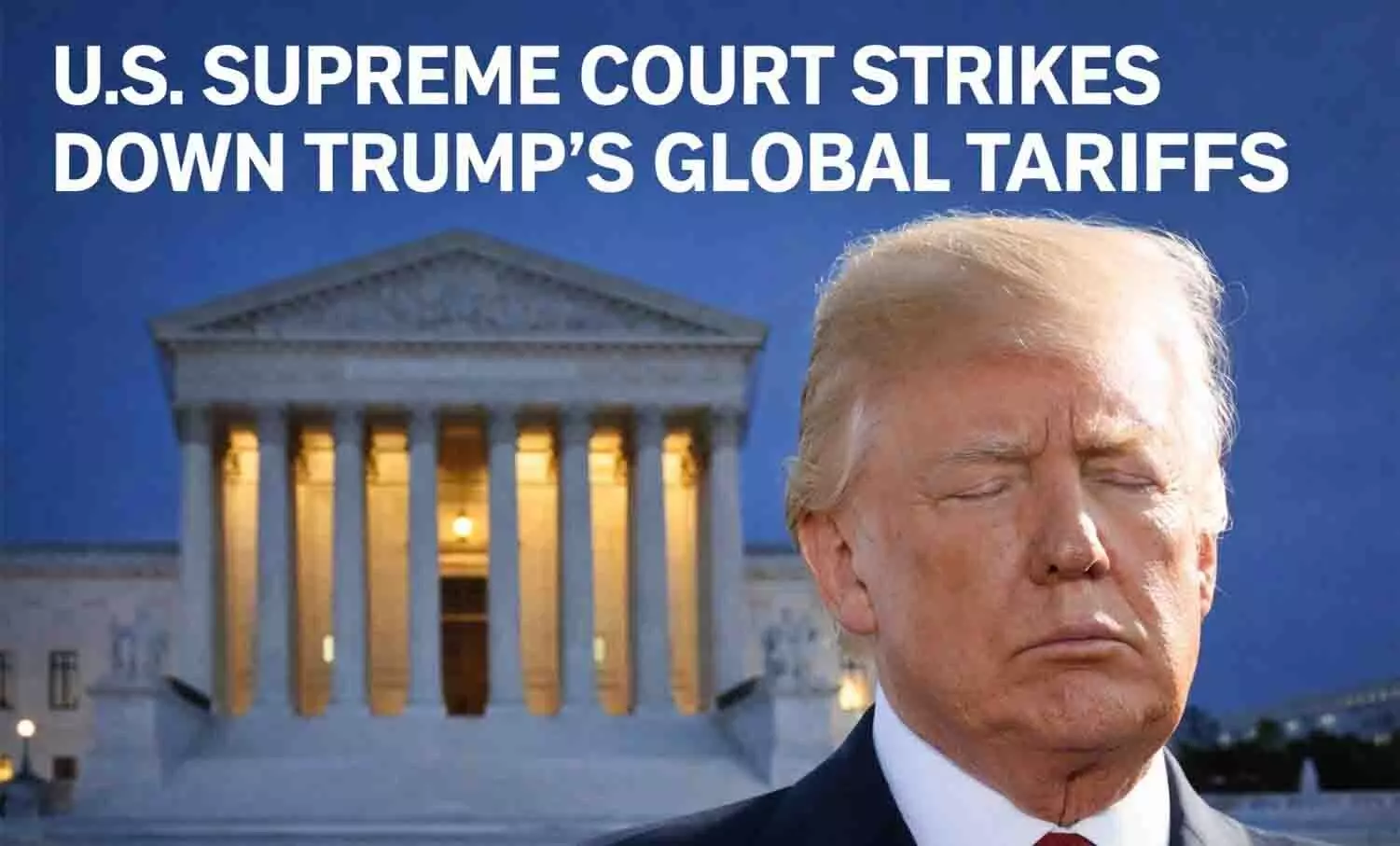
US Supreme Court Strikes Down Trump Global Tariff, Trump calls judges a disgrace to the country; announces 10% global tariffs worldwide


Key Highlights
- US Supreme Court invalidates Trump’s Global Tariff in 6–3 decision.
- India’s 18% reciprocal tariff declared unlawful.
- Court rules tariff power rests with Congress, not the President.
- Over $200 billion collected; refund questions remain unresolved.
In a landmark constitutional and economic ruling, the US Supreme Court has struck down President Donald Trump’s sweeping Global Tariff regime, declaring that the authority to impose broad-based tariffs lies with Congress—not the President. The 6–3 decision invalidates the controversial reciprocal tariff framework introduced in April 2025, including the 18% Indian tariff imposed on goods exported from India to the United States. The verdict is being described as one of the most consequential trade and executive power rulings in modern American history.
President Trump was furious after the Supreme Court's ruling. He not only called some judges a disgrace to the country, but also announced a 10 percent global tariff.
बड़ी खबर: US Supreme Court का Trump Tariff पर ऐतिहासिक फैसला
अमेरिकी सुप्रीम कोर्ट ने डोनाल्ड ट्रम्प के ग्लोबल टैरिफ को 6-3 से अवैध घोषित किया। भारत पर लगा 18% Indian Tariff भी रद्द। जानें पूरा असर।
इस खबर को हिंदी में पढ़ेंTrump Tariff Verdict Explained
The Court held that taxation and tariff powers constitutionally belong to Congress. The President cannot use emergency economic law to impose sweeping global import taxes.
Why the Supreme Court Rejected the Trump Tariff
The majority opinion emphasized that tariffs function as taxes on imports and, under the US Constitution, taxation authority is explicitly granted to Congress. While the executive branch retains certain emergency economic powers, the Court concluded that those powers do not extend to creating wide-ranging global tariff systems affecting multiple countries simultaneously.
The ruling directly challenges the legal interpretation used by the Trump administration, which relied on the International Emergency Economic Powers Act (IEEPA) of 1977 to justify imposing the Global Tariff.
Trump announced 10% global tariff worldwide
Just three hours after the US Supreme Court's decision to strike down the tariffs, Donald Trump announced a 10% tariff worldwide. Trump said he would sign an order today imposing an additional 10% tariff on top of the baseline tariffs worldwide. Trump vented his anger on the judges.
He further stated that it was disappointing that some judges were a disgrace to the country. They lacked the courage to do what was right for our country. We are ashamed of them. The judges are the stooges of the radical left. They are neither loyal to the Constitution nor displaying patriotism. They are cowards, and therefore lack the ability to make the right decisions.
However, Trump also praised the three conservative judges who dissented from the decision. Criticizing the judges who struck down the tariffs, Trump said, "They are against everything that makes America strong and great again. They are a disgrace to our country. They are the judges who say 'no' all the time."
The 18% Indian Tariff and Its Significance
Among the most closely watched elements of the decision is the invalidation of the 18% reciprocal tariff applied to Indian exports. The Indian tariff had impacted sectors such as pharmaceuticals, engineering goods, textiles, and auto components. Indian exporters had faced increased compliance costs and price competitiveness challenges in the US market.
With the tariff declared unlawful, Indian businesses may regain pricing advantages. Trade analysts say this could reset portions of India-US trade negotiations and potentially revive stalled bilateral commercial discussions.
Understanding IEEPA and Executive Power Limits
The Trump administration invoked IEEPA, arguing that persistent trade deficits constituted a national emergency. The law, enacted in 1977, was designed to allow presidents to respond swiftly to extraordinary foreign threats by regulating financial transactions or freezing assets.
The Supreme Court noted that the statute does not explicitly mention tariffs and does not grant unlimited taxation authority. The majority concluded that stretching IEEPA to justify global tariffs would undermine the constitutional separation of powers.
What Tariffs Remain in Place?
The ruling does not eliminate all tariffs introduced during Trump’s presidency. Steel and aluminum tariffs imposed under separate trade statutes remain intact. However, two major categories have been invalidated:
- Reciprocal tariffs, including the 34% tariff on China and the 10% baseline tariff on multiple countries.
- The 25% tariffs applied to selected imports from Canada, China, and Mexico tied to fentanyl-related enforcement claims.
This distinction underscores that not all executive trade actions are unconstitutional—only those exceeding statutory and constitutional authority.
$200 Billion Collected: The Refund Question
Reports indicate that the administration collected over $200 billion in tariff revenue under the Global Tariff program. The Supreme Court’s ruling leaves unresolved whether affected companies are entitled to refunds.
Multiple corporations had already filed legal claims seeking reimbursement of tariffs paid. If refund obligations are enforced, the financial consequences for the US Treasury could be substantial. Legal experts expect further litigation to clarify repayment obligations.
The Political and Economic Fallout for Trump
President Trump had previously warned that losing the tariff case would weaken America’s negotiating leverage and harm domestic industry. The Court’s decision is widely viewed as a setback for his economic doctrine centered on aggressive tariff-based trade rebalancing.
Three justices dissented, arguing that while the tariff policy’s economic wisdom could be debated, the legal authority under emergency powers might have been interpreted more broadly.
Impact on India and Global Trade Architecture
For India, the decision removes immediate tariff pressure and may restore confidence among exporters targeting the US market. It also reinforces the importance of predictable trade frameworks for emerging economies.
Globally, the ruling may influence how future US administrations approach tariff policy. Markets responded cautiously, with investors weighing the possibility of refund liabilities against renewed trade stability.
Future Outlook: Executive Trade Powers Redefined
The judgment is likely to redefine the boundaries of presidential trade authority. Future administrations may need explicit congressional approval for sweeping tariff initiatives. Analysts say this strengthens legislative oversight in trade policy but could slow rapid economic responses during crises.
The case also raises broader constitutional questions about emergency powers, separation of powers, and the evolving structure of global commerce in an era of geopolitical competition.

Global Tariff Decision Brief
- Supreme Court limits executive tariff authority
- India’s 18% tariff struck down
- Over $200B collected under scrutiny
- Congressional power over taxation reaffirmed
The Supreme Court ruling reshapes US trade law, impacts India-US commerce, and challenges the scope of presidential emergency powers.
Frequently Asked Questions
Why did the US Supreme Court strike down the Trump tariff?
The Court ruled that tariff and taxation powers constitutionally belong to Congress, not the President acting unilaterally.
What happens to the 18% Indian tariff?
The tariff imposed on Indian exports has been declared unlawful and is no longer valid under the ruling.
Are all Trump-era tariffs cancelled?
No. Tariffs imposed under separate statutory authority, such as steel and aluminum duties, remain in effect.
Will companies receive refunds of collected tariffs?
The Court did not clarify refund obligations. Further legal proceedings are expected to determine repayment responsibilities.
How does this affect global trade?
The decision reinforces constitutional limits on executive trade actions and may create a more predictable framework for international commerce.

Rewa Riyasat News
2013 में स्थापित, RewaRiyasat.Com एक विश्वसनीय न्यूज़ पोर्टल है जो पाठकों को तेज़, सटीक और निष्पक्ष खबरें प्रदान करता है। हमारा उद्देश्य स्थानीय से लेकर राष्ट्रीय व अंतरराष्ट्रीय घटनाओं तक की भरोसेमंद जानकारी पहुंचाना है।