


First Time in 23 Years: Iran Downs US F-15E as Asymmetric Warfare Stuns Washington
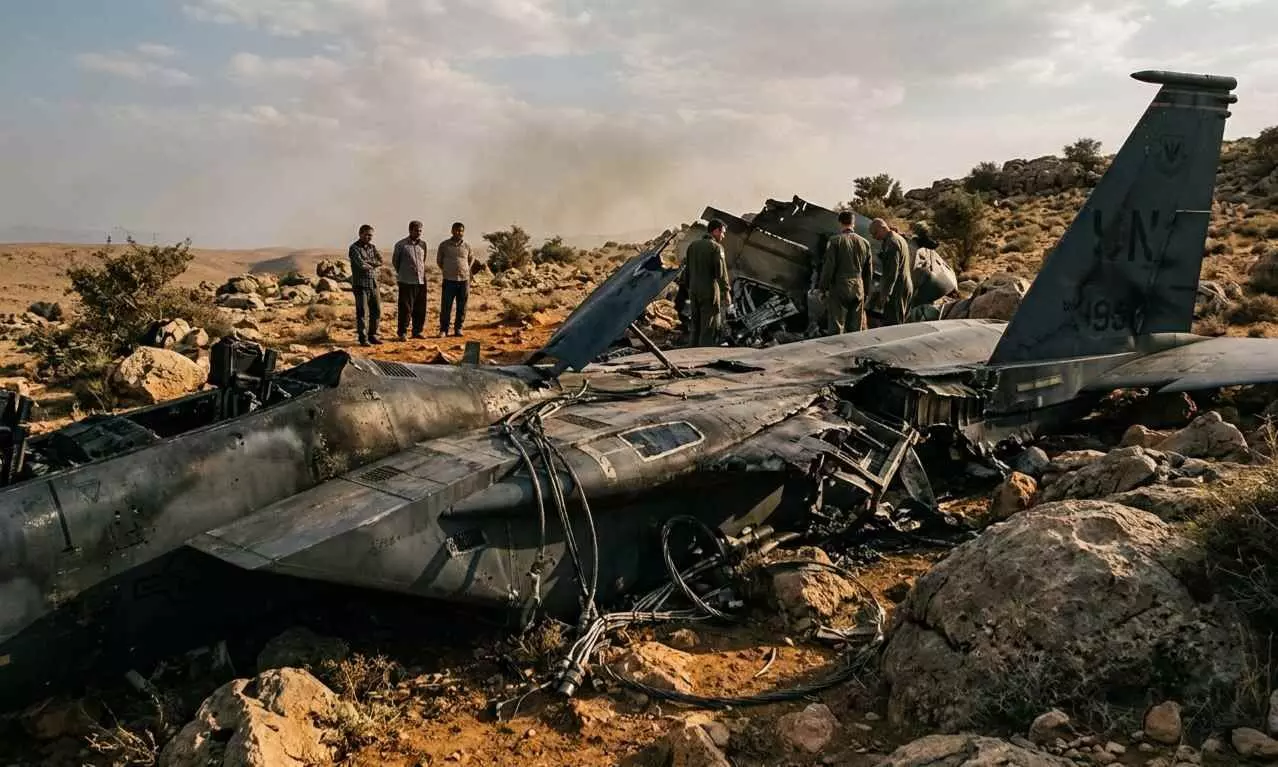


The sky over the Middle East has become a dangerous theater of war where reality is quickly clashing with political rhetoric. Just hours after President Donald Trump addressed the American public, claiming that the United States had achieved total dominance over Iranian airspace, the reality on the ground—and in the air—told a much grimmer story. For the first time in over two decades, American fighter jets have been brought down by enemy fire, signaling a major shift in a conflict that is proving far more unpredictable than Washington anticipated.
On April 2, President Trump delivered a 19-minute televised speech, confidently stating that the Iranian Air Force had been "decimated" and that US planes were flying over Tehran without resistance. This sentiment was echoed by Secretary of State Marco Rubio. However, within 24 hours of these bold proclamations, the US military suffered a string of humiliating losses. Two sophisticated combat jets and two Blackhawk rescue helicopters were targeted by Iranian forces, proving that the Iranian "shield" is far from broken.
The most significant loss involved a Boeing F-15E Strike Eagle, which was patrolling the southwestern region of Iran. According to reports, this marks the first time since the Iraq War in 2003 that a US fighter jet has been shot down by an enemy combatant. The drama intensified when an A-10 Thunderbolt II, sent to provide cover for the downed crew, was also hit. While the A-10 pilot managed to limp the aircraft back to Kuwaiti airspace before ejecting safely, the F-15E was not as lucky. One crew member has been rescued, but another remains missing, with Iranian state media suggesting they may have landed in southern Iran.
To understand the gravity of the situation, one must look at the mounting toll of the past 35 days. The United States has now lost a total of seven aircraft in the Iranian theater. The losses began on March 2, when three F-15s were lost to "friendly fire" in Kuwait. This was followed by a tragic KC-135 tanker crash in Iraq on March 12 that claimed six lives, and the destruction of a high-tech E-3 Sentry on the ground in Saudi Arabia on March 27. The latest losses of the F-15E and A-10 represent a new escalation: direct hits from the enemy.
Military experts are now questioning how Iran, despite heavy bombardment, is still able to swat advanced American jets out of the sky. The answer lies in "asymmetric warfare." Iran realizes it cannot win a traditional "dogfight" against the US Air Force. Instead, they are using a "hide and seek" strategy. They have abandoned large, easy-to-spot radar stations and moved toward mobile, stealthy defense systems that are hidden in tunnels, mountains, and underground bunkers.
One of the primary suspects in these recent shoot-downs is the "Majid" Air Defense System. Unlike traditional systems that use radar—which US jets can detect and jam—the Majid system uses infrared (heat-seeking) technology. It acts like a silent hunter. Because it doesn't emit a radar signal, the American pilots have no warning that a missile is coming until it is too late. The Majid is small, mounted on the back of trucks, and can hit targets up to 6 kilometers high. It appears the US jets were flying at lower altitudes to identify ground targets, placing them right in the Majid’s "kill zone."
The impact of these losses is both psychological and strategic. For the American public, the image of "invincibility" created by the administration has been shaken. If Iran can continue to hide its mobile launchers and use "fire and scoot" tactics—where they shoot a missile and move the launcher within minutes—the US will find it nearly impossible to claim true "control" of the skies. Experts believe Iran still has nearly 50% of its mobile missile launchers intact, hiding in the rugged Iranian terrain.
As the conflict enters its second month, the "easy victory" promised by many in Washington seems to be disappearing. While the US possesses the most advanced military technology in the world, Iran’s use of low-cost, high-efficiency mobile defenses is proving to be a formidable challenge. The missing F-15E crew member remains a high-stakes priority, and the world is watching to see if the US will change its flight patterns or double down on a strategy that Iran has clearly begun to decode.
In conclusion, the events of the last 24 hours serve as a sobering reminder that in modern warfare, control is often an illusion. While President Trump speaks of a conquered sky, the wreckage of multimillion-dollar jets in the Iranian desert suggests that the path to peace or total victory remains long, dangerous, and incredibly costly.

Rewa Riyasat News
2013 में स्थापित, RewaRiyasat.Com एक विश्वसनीय न्यूज़ पोर्टल है जो पाठकों को तेज़, सटीक और निष्पक्ष खबरें प्रदान करता है। हमारा उद्देश्य स्थानीय से लेकर राष्ट्रीय व अंतरराष्ट्रीय घटनाओं तक की भरोसेमंद जानकारी पहुंचाना है।