


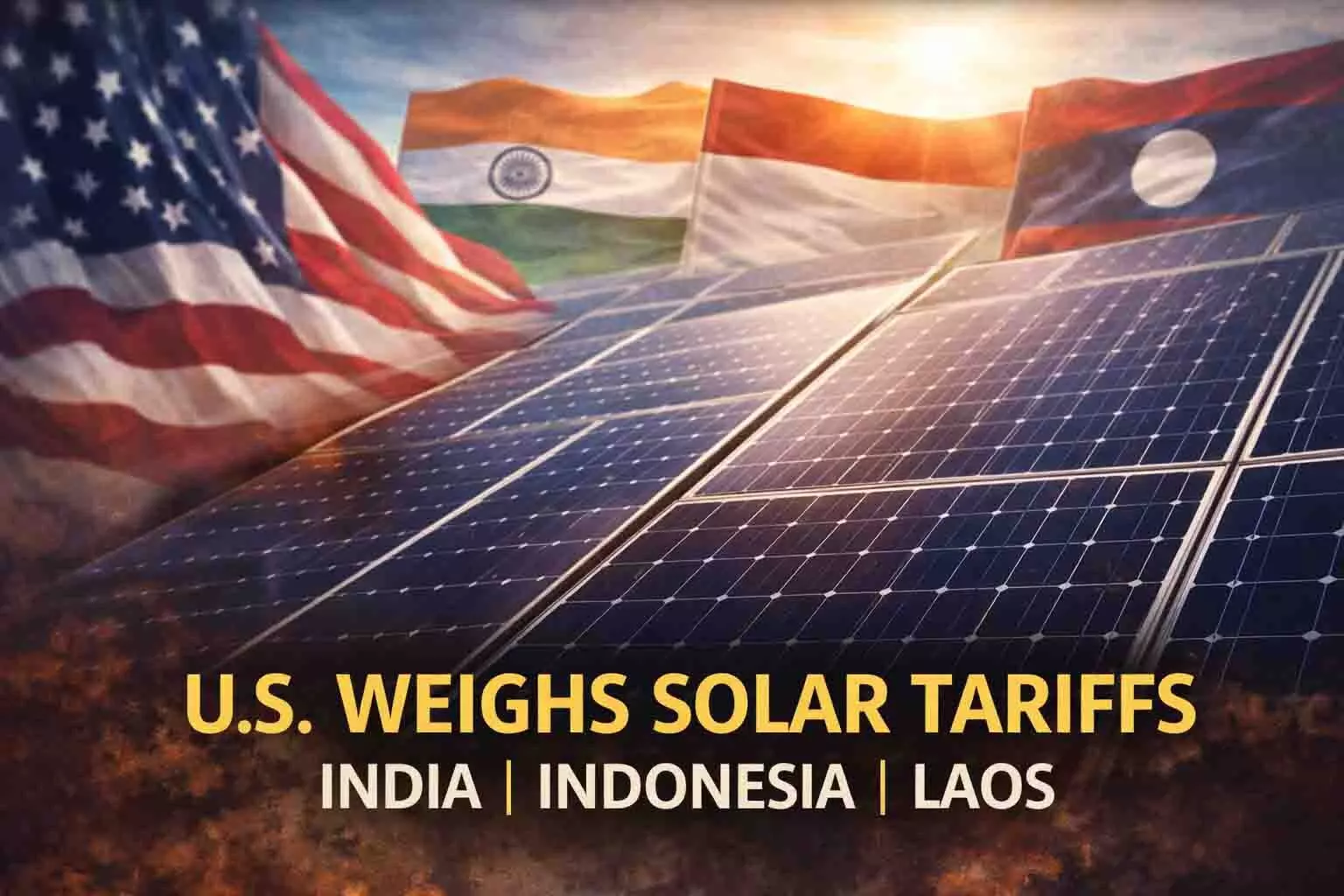
US Weighs New Tariffs on Solar Imports from India, Indonesia and Laos


Key Highlights
- US to announce preliminary decision on solar import duties
- India, Indonesia and Laos under review for alleged subsidies
- Separate anti-dumping decision expected next month
- Case backed by US solar manufacturers protecting factory investments
The United States is set to take a significant step in a fast-evolving solar trade dispute, as the Commerce Department prepares to announce whether solar cells and panels imported from India, Indonesia and Laos should face anti-subsidy duties.
Why This Matters
The decision could reshape global solar supply chains, impact renewable energy costs in the US and influence export strategies in India and Southeast Asia.
What the US Commerce Department Is Reviewing
The Commerce Department’s preliminary determination focuses on whether companies operating in India, Indonesia and Laos received government subsidies that unfairly support their production of solar cells and panels. If confirmed, countervailing duties could be imposed to offset those subsidies and protect domestic manufacturers.
The ruling marks the first of two major decisions expected in this case. A separate review next month will address allegations that foreign manufacturers sold solar products in the US at prices below their production costs, a practice commonly referred to as dumping.
Who Filed the Complaint
The trade case was initiated by the Alliance for American Solar Manufacturing and Trade, a group representing parts of the US solar manufacturing industry. The coalition includes major players such as Hanwha Qcells and Arizona-based First Solar, both of which have invested heavily in expanding US solar production facilities.
The group argues that unfairly priced imports undermine billions of dollars in domestic manufacturing investments and threaten the long-term competitiveness of US-based solar factories.
Allegations in the Petition
The petition alleges that certain Chinese manufacturers shifted production to Indonesia and Laos after earlier US tariffs targeted other Southeast Asian countries. It also accuses Indian-headquartered solar producers of exporting products to the United States at artificially low prices.
Industry observers note that similar trade actions in the past led to tariffs on imports from Malaysia, Cambodia, Vietnam and Thailand. Those measures significantly altered sourcing strategies for US solar developers.
Implications for India, Indonesia and Laos
For India, which has positioned itself as a growing solar manufacturing hub, the decision could affect export competitiveness in the US market, one of the world’s largest solar energy consumers. Indian manufacturers have been scaling production amid strong domestic renewable energy targets.
Indonesia and Laos, meanwhile, have emerged as alternative production bases in Southeast Asia. Any imposition of duties could disrupt supply chains and prompt companies to reassess manufacturing locations.
Impact on US Renewable Energy Goals
The case comes at a delicate time for the US renewable energy sector. While tariffs may protect domestic manufacturing, they can also raise short-term costs for project developers reliant on imported solar modules.
Balancing industrial policy with clean energy deployment remains a central challenge for policymakers. The US has been encouraging domestic solar manufacturing under broader industrial and climate initiatives, but project developers warn that trade barriers could slow installations if costs rise.
Global Solar Market Context
The global solar industry has experienced rapid expansion over the past decade, with Asia playing a dominant role in manufacturing. Trade disputes have increasingly shaped market dynamics, as governments seek to secure domestic supply chains while maintaining access to affordable renewable technology.
Analysts say the upcoming decision may influence not only bilateral trade relations but also broader strategic alignments in the clean energy transition.
What Happens Next
The preliminary ruling expected this week will outline whether countervailing duties are warranted. Final determinations are likely later this year, following additional investigations and stakeholder input.
Companies exporting solar products to the US may face provisional tariffs in the interim period, depending on the outcome. Investors and policymakers across the US, India, Indonesia and Laos will be closely watching the announcement for signals on future trade direction.

Trade Insight
- US reviewing subsidy claims in solar imports
- India, Indonesia and Laos under scrutiny
- Anti-dumping decision expected next month
- Potential impact on global renewable supply chains
Frequently Asked Questions
What is the US reviewing in this case?
The Commerce Department is examining whether solar manufacturers in India, Indonesia and Laos received unfair government subsidies.
What are countervailing duties?
They are tariffs imposed to offset subsidies provided by foreign governments that give exporters an unfair pricing advantage.
Will there be additional decisions?
Yes, a separate anti-dumping decision is expected next month.
How could this affect solar prices in the US?
If tariffs are imposed, short-term module costs could increase for developers.
When will final decisions be made?
Final determinations are expected later this year following further investigation.

Rewa Riyasat News
2013 में स्थापित, RewaRiyasat.Com एक विश्वसनीय न्यूज़ पोर्टल है जो पाठकों को तेज़, सटीक और निष्पक्ष खबरें प्रदान करता है। हमारा उद्देश्य स्थानीय से लेकर राष्ट्रीय व अंतरराष्ट्रीय घटनाओं तक की भरोसेमंद जानकारी पहुंचाना है।