


US Court Orders Refund of Trump Tariffs Worth Up to $175 Billion
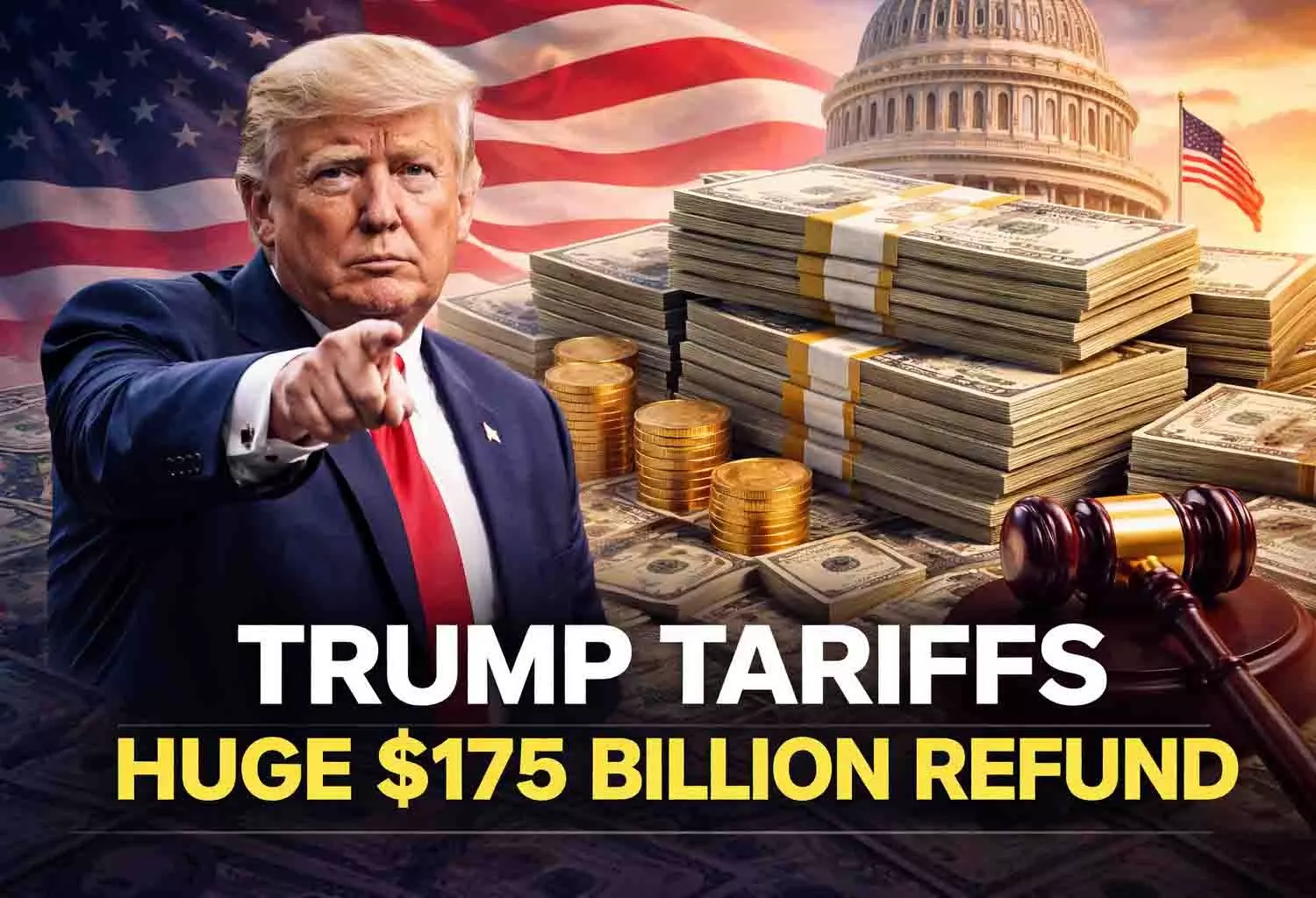


- US court orders refund of Trump-era tariffs collected from companies
- Up to $175 billion (₹14.5 lakh crore) may be returned
- Tariffs worth ₹10.79 lakh crore collected until December
- Supreme Court ruled tariff authority belongs to Congress
A US trade court has ordered the government to refund billions of dollars collected under tariffs imposed by former President Donald Trump. According to court filings, companies could receive refunds worth up to $175 billion (about ₹14.5 lakh crore) after judges ruled that the tariffs were imposed without proper congressional authority. The ruling follows a Supreme Court decision earlier this year that questioned the legality of the tariff powers used by the Trump administration.
Why the ruling matters
The case could reshape how US presidents use emergency economic powers to impose tariffs and may affect global trade relations.
US court orders tariff refunds
The US Court of International Trade instructed the government to return tariff payments collected under the disputed policy. Companies had challenged the duties, arguing that the president lacked the legal authority to impose them.
According to court documents, tariffs had generated significant revenue by December, and the total amount potentially eligible for refunds could reach billions of dollars once recalculations are completed.
Legal dispute reaches the Supreme Court
The controversy surrounding the tariffs intensified after the US Supreme Court ruled in February 2026 that the power to impose tariffs ultimately rests with Congress, not the president.
The court determined that tariffs function as a form of taxation, meaning they fall within the legislative authority of Congress rather than the executive branch.
The decision did not initially clarify how companies would recover the duties they had already paid, leaving uncertainty about possible refunds.
Judge Richard Eaton to oversee refund process
The refund order emerged from a case filed by Tennessee-based filtration company Atmus Filtration Technologies. Judge Richard Eaton ruled that tariffs involved in pending cases must be removed and recalculated.
Eaton also stated that he would personally oversee the refund-related hearings to prevent delays or complications in the process.
The judge was appointed to the Court of International Trade in 1999 by former President Bill Clinton.
Billions of dollars in potential refunds
Court documents indicate that tariff collections had already reached approximately ₹10.79 lakh crore by December. However, after recalculations and pending legal claims, the total refund liability could rise to nearly $175 billion (₹14.5 lakh crore).
If implemented fully, the refund order could become one of the largest financial reversals linked to US trade policy in recent years.
Trump administration’s options
The US government now faces several potential paths forward following the court ruling. Officials may appeal the decision to a higher court, request a temporary stay of the refund order, or delay refunds through administrative procedures.
Under US customs regulations, importers have up to 180 days to challenge final duty calculations, which could extend the refund timeline.
Disagreement among Supreme Court justices
The Supreme Court’s ruling on the tariffs was not unanimous. Three justices—Samuel Alito, Clarence Thomas and Brett Kavanaugh—expressed dissenting views.
Kavanaugh wrote that while debates over tariff policy were valid, he believed the measures could be legally justified due to their connection with foreign policy and national security concerns.
His note also referenced tariffs imposed on countries over issues such as energy trade, including policies targeting purchases of Russian oil.
Trump raised tariffs after court criticism
Following criticism from the Supreme Court, Donald Trump announced a new increase in global tariffs, raising the rate from 10 percent to 15 percent.
The new tariff policy was implemented through an executive order and applied to imports from multiple countries beginning in late February.
Trump also criticized judges who questioned the legality of his tariff strategy, arguing that his actions were necessary to protect US economic interests.
The law at the center of the dispute
The legal controversy revolves around the International Emergency Economic Powers Act (IEEPA), a law enacted in 1977.
The legislation allows US presidents to respond quickly to extraordinary threats such as war, major economic crises, or national security emergencies by restricting foreign financial transactions or economic activity.
Trump relied on the law to justify imposing tariffs on multiple countries, arguing that certain international trade conditions posed economic threats to the United States.
Lower courts previously ruled tariffs illegal
Before reaching the Supreme Court, lower courts—including the Court of International Trade and the Federal Circuit Court—had already ruled against the tariffs.
Those courts concluded that the emergency powers law did not grant the president broad authority to impose tariffs without congressional approval.
The Supreme Court later reviewed the case after hearing arguments in late 2025, where several justices questioned whether the executive branch could impose such large-scale tariffs without legislative oversight.
Join WhatsApp Channel Follow on Google NewsFAQs
Why did the US court order refunds for Trump tariffs?
The court ruled that tariffs imposed under emergency powers were not legally authorized, requiring recalculation and refunds to affected companies.
Who has the authority to impose tariffs in the United States?
The US Supreme Court stated that tariff authority ultimately belongs to Congress.
What law was used to justify the tariffs?
The Trump administration relied on the International Emergency Economic Powers Act of 1977.
How much money could be refunded?
Billions of dollars collected through tariffs may be returned once calculations are completed.
What options does the US government have now?
The government may appeal the ruling, request a temporary stay, or delay refunds through administrative procedures.

Neelam Dwivedi
Neelam Dwivedi is an experienced digital content editor in the field of journalism. She has been working with the Rewa Riyasat news portal since 2016, managing and editing news content in both Hindi and English. She covers a wide range of topics, including national and international news, politics, sports, technology, health, lifestyle, and social issues. Her work focuses on presenting clear, accurate, and easy-to-understand news for readers while staying updated with the latest trends in digital media.