


Global Internet Blackout? How the Strait of Hormuz Conflict Could Wipe Out Your Web Speed
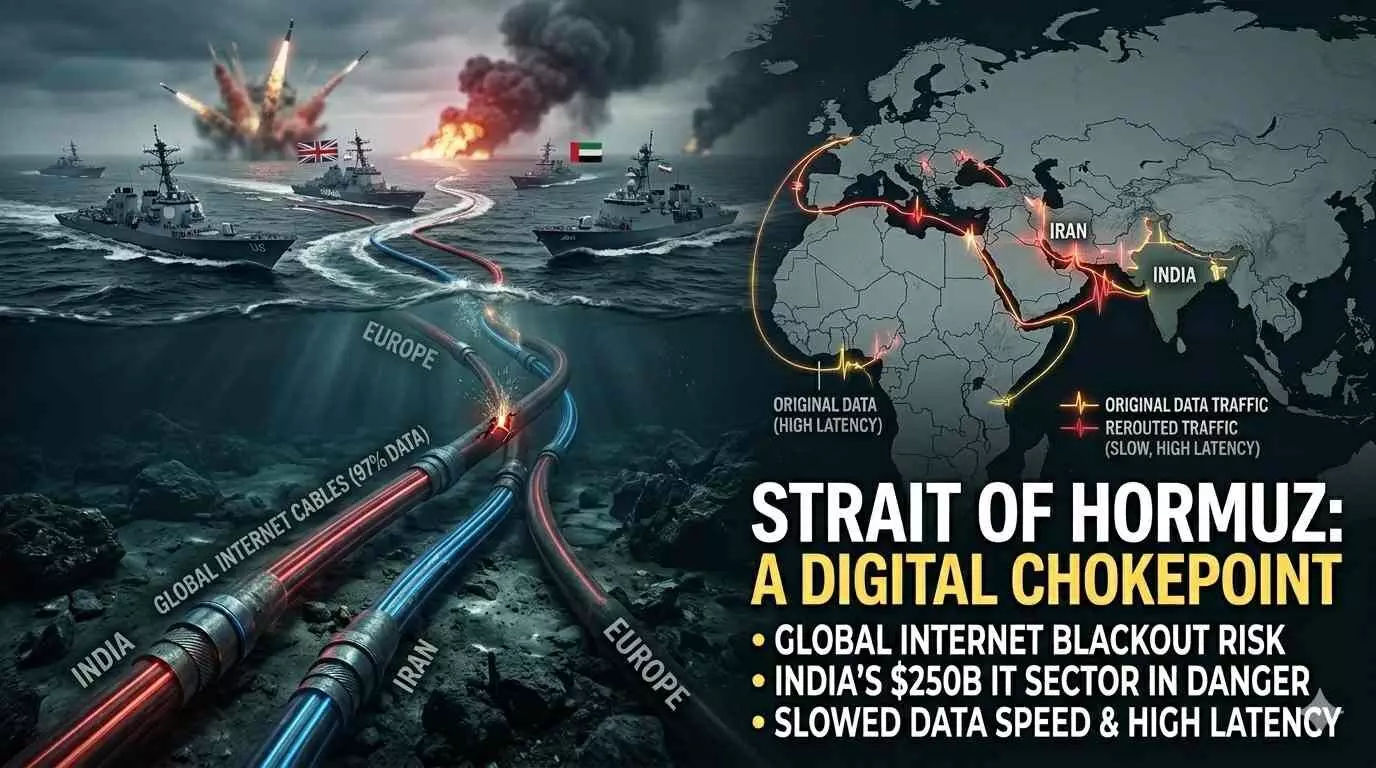


The world is currently watching the Strait of Hormuz with bated breath. While most of the focus has been on the rising prices of oil and gas due to the conflict involving the U.S., Israel, and Iran, a much more silent and terrifying threat is emerging. Experts are now warning of a potential global internet "blackout" or a massive slowdown that could change how we live and work overnight. This narrow stretch of water is no longer just an energy chokepoint; it has officially become a "digital chokepoint" that holds the keys to the world's connectivity.
Most people believe that the internet works through satellites floating in space. However, the reality is that about 97% of all global data—including your WhatsApp messages, YouTube videos, and bank transfers—travels through tiny glass wires called fiber-optic cables buried deep under the ocean. These cables are the nervous system of our modern world, and many of the most important ones run right through or near the volatile waters of the Middle East.
The Hidden Infrastructure: 97% of Data is Under the Sea
If you think of the internet as a giant highway, these undersea cables are the main expressways. They connect continents, allowing data to travel at the speed of light from a server in the United States to a smartphone in Mumbai. The Strait of Hormuz and the surrounding Gulf region are packed with these cables because they provide the shortest and most efficient path between Europe, Africa, and Asia.
Major cable systems like SEA-ME-WE (South East Asia-Middle East-Western Europe), AAE-1, and EIG are the lifelines for India’s connection to the Western world. Because these cables are physically located on the seabed, they are vulnerable to anchors, earthquakes, and—most worryingly right now—military activity. In a high-tension war zone, deep-sea explosions or deliberate sabotage could cut these lines, instantly disconnecting millions of people.
Why India Faces a Unique Digital Danger
For India, this isn't just about slow Netflix buffering; it is a direct threat to the nation’s economic backbone. India has built a massive digital economy that relies almost entirely on international bandwidth coming through the Arabian Sea and the Gulf region. If these "digital arteries" are severed, the consequences would be felt in every corner of the country.
The first major issue would be "latency." When a cable is cut, internet providers have to send data the long way around—usually across the Pacific Ocean. This makes the data take longer to travel. For a regular user, this means video calls will lag, and websites will take forever to load. But for big businesses, "latency" is a word that costs millions of dollars. High-frequency trading on the stock market, where every millisecond counts, could face massive financial risks if the connection speed drops even slightly.
The Threat to India’s $250 Billion IT Industry
India’s IT and outsourcing sector is worth approximately $250 billion (about 23.48 lakh crore rupees). This industry provides services to giant American and European companies in real-time. Whether it is a call center in Bengaluru helping a customer in London or a software engineer in Hyderabad fixing a server in New York, the entire system depends on a stable, low-latency internet connection.
If the cables in the Strait of Hormuz are damaged, many IT companies could fail to meet their Service Level Agreements (SLAs). This could lead to heavy penalties and a loss of trust from international clients. Furthermore, critical banking systems like SWIFT, which handle international money transfers, could slow down, affecting the billions of dollars in remittances that Indian workers send home from the Gulf countries every year.
Total Blackout vs. The Great Slowdown
Is it possible that the internet will stop working entirely? Luckily, the answer is likely no. The internet was designed to be "redundant," meaning if one path is blocked, the data automatically looks for another way to reach its destination. If a cable is cut in the Middle East, your data might travel through the Pacific or across land cables in Central Asia.
However, while the internet might stay "on," it will be incredibly slow. Imagine taking all the traffic from a 10-lane highway and forcing it into a single-lane dirt road. The congestion would be massive. Most people would experience constant bufferings, failed uploads, and unusable cloud services. This "Great Slowdown" would still be enough to disrupt schools, hospitals, and government offices that now rely on the cloud for daily operations.
Seeking New Horizons: India’s Plan B
Recognizing this vulnerability, India and other global powers are moving quickly to find alternatives. One major solution being discussed is satellite internet. Companies like Elon Musk’s Starlink are being viewed as a vital "backup plan." Because satellites don't rely on undersea cables, they can provide a connection even if the seabed is in a state of war.
Additionally, India is investing in new cable routes that bypass sensitive areas like the Strait of Hormuz entirely. Plans are in place to lay cables that go through different territories or deeper waters that are harder to reach. While these projects take years to complete, the current crisis has made them a top priority for national security. For now, the world remains on edge, hoping that the tension in the Strait doesn't pull the plug on our digital lives.
The New Face of Warfare
In the past, wars were fought over land and gold. Today, they are fought over oil and data. The threat to the undersea cables in the Strait of Hormuz proves that our modern civilization is more fragile than we think. While we often take our high-speed internet for granted, it is held together by thin glass strands at the bottom of the ocean. As the geopolitical storm continues to brew, the digital safety of billions of people hangs in the balance, proving that in 2026, a "cable cut" can be just as damaging as a bomb.

Rewa Riyasat News
2013 में स्थापित, RewaRiyasat.Com एक विश्वसनीय न्यूज़ पोर्टल है जो पाठकों को तेज़, सटीक और निष्पक्ष खबरें प्रदान करता है। हमारा उद्देश्य स्थानीय से लेकर राष्ट्रीय व अंतरराष्ट्रीय घटनाओं तक की भरोसेमंद जानकारी पहुंचाना है।