


IDFC First Bank ₹590 Crore Fraud Shock: RBI Says No Systemic Risk as Stock Hits 20% Lower Circuit


Top Developments
- IDFC First Bank disclosed a ₹590 crore fraud at its Chandigarh branch.
- RBI Governor Sanjay Malhotra said there is no systemic issue.
- Shares hit 20% lower circuit on BSE amid sharp investor reaction.
- Internal probe underway; four officials suspended, police complaint filed.
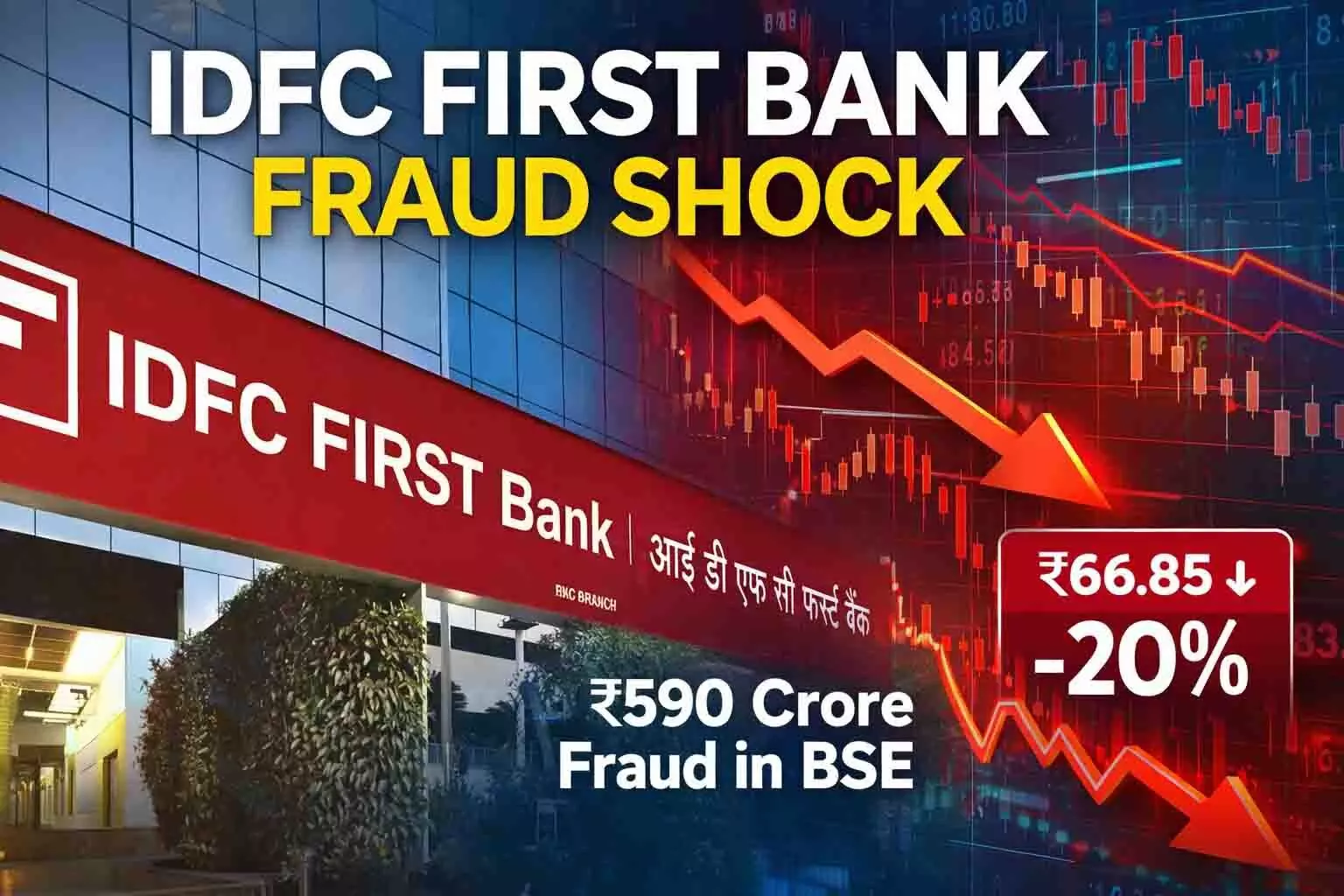
Shares of IDFC First Bank witnessed intense selling pressure after the lender disclosed a ₹590 crore fraud at its Chandigarh branch, triggering a 20% lower circuit on the Bombay Stock Exchange. The sharp market reaction followed the bank’s admission that certain employees allegedly carried out unauthorised transactions involving a specific set of Haryana government-linked accounts. Even as the stock tumbled, the Reserve Bank of India moved swiftly to calm concerns, stating that the issue does not pose any systemic risk to the banking sector.
What Triggered the Sell-Off?
The disclosure of a large fraud amounting to ₹590 crore led to panic selling in early trade, pushing the stock to the lower circuit as investors reacted to governance concerns.
Fraud Confined to Specific Government-Linked Accounts
The private sector lender informed exchanges that the suspected fraud was confined to a particular group of government-linked accounts within the Haryana Government operated through its Chandigarh branch. The bank clarified that the irregularities do not extend to other customers of the branch or to its wider operations. This distinction became central to regulatory communication as authorities sought to prevent broader panic in financial markets.
According to the exchange filing, certain employees allegedly executed unauthorised transactions over a period of time. While the bank has not disclosed granular operational details pending investigation, it confirmed that four officials believed to be connected with the case have been suspended. A formal complaint has also been filed with law enforcement agencies.
RBI Response: No Systemic Risk
Speaking after a post-budget interaction with the RBI Central Board following the Finance Minister’s customary address, RBI Governor Sanjay Malhotra stated that the central bank is closely monitoring developments. He emphasized that there is no systemic issue arising from the incident.
The regulator’s reassurance aimed to stabilize sentiment at a time when concerns over governance lapses can quickly spill into broader market anxiety. In India’s tightly regulated banking environment, the RBI maintains supervisory oversight over private and public sector lenders alike, often stepping in to ensure depositor confidence remains intact.
Stock Market Reaction: Lower Circuit and Heavy Volumes
On the BSE, IDFC First Bank shares fell 20% to hit the lower circuit at ₹66.85 during early trade. On the NSE, the stock dropped sharply, trading nearly 19% lower at one point. This marked a stark reversal from the previous week when the stock had ended in the green.
Market participants pointed to a combination of factors driving the sell-off. Beyond the headline fraud figure, concerns emerged around internal controls, compliance mechanisms, and potential reputational damage. In financial markets, perception often moves faster than detailed facts, particularly in the first trading session after a major disclosure.
Trading volumes surged significantly, reflecting both panic selling and opportunistic buying by investors who believe the correction may be overdone if the fraud remains isolated.
Internal Controls and Governance Under Scrutiny
The incident has once again spotlighted governance standards within India’s banking system. While fraud cases are not uncommon in global banking, the magnitude and involvement of internal personnel tend to raise questions around audit oversight and compliance checks.
IDFC First Bank has stated that it will pursue strict disciplinary, civil and criminal action against those responsible. The outcome of the internal investigation will be critical in determining whether the lapse was limited to a small group or indicative of deeper process gaps.
Industry experts note that banks typically maintain multi-layered internal control systems, including periodic audits, transaction monitoring software, and regulatory inspections. When breaches occur, regulators assess not only the immediate financial impact but also the adequacy of remedial measures.

Market Impact Brief
- Fraud amount disclosed at ₹590 crore in Chandigarh branch.
- RBI monitoring situation; no systemic banking risk indicated.
- Stock hit 20% lower circuit amid heavy selling pressure.
- Four officials suspended; police complaint filed.
- Investors watching internal probe outcome and regulatory updates.
India’s Banking Stability Context
India’s banking sector has undergone significant reforms over the past decade, including tighter non-performing asset recognition norms, enhanced supervisory mechanisms, and the strengthening of insolvency processes. The RBI’s swift communication in this case reflects a broader effort to prevent contagion effects in financial markets.
Globally, banking systems are particularly sensitive to fraud disclosures because they can trigger concerns about liquidity and solvency even when such fears are unfounded. Analysts say that early and transparent disclosure, coupled with regulatory assurance, often plays a decisive role in restoring stability.
Investor Sentiment and Outlook
In the near term, the stock may remain volatile as traders digest developments and await further clarity from the bank. Institutional investors are likely to assess the potential financial hit relative to the bank’s balance sheet strength and capital adequacy position.
If investigations confirm that the fraud is limited in scope and provisioning impact remains manageable, sentiment could stabilize. However, any indication of wider exposure could prolong uncertainty.
Market strategists suggest that beyond immediate price action, the episode reinforces the importance of governance transparency in sustaining investor trust. For retail investors especially, headline-driven volatility underscores the need to evaluate long-term fundamentals rather than react solely to short-term shocks.
Join WhatsApp Channel Follow on Google NewsFrequently Asked Questions
What is the amount involved in the IDFC First Bank fraud?
The bank disclosed a fraud of ₹590 crore linked to specific Haryana government-related accounts operated through its Chandigarh branch.
Did the RBI indicate broader banking risk?
The RBI Governor stated that there is no systemic issue and that the central bank is closely monitoring developments.
How did the stock market react?
Shares fell sharply, hitting the 20% lower circuit on the BSE and declining significantly on the NSE amid heavy selling.
What action has the bank taken?
The bank has suspended four officials allegedly linked to the fraud and filed a complaint with police authorities while initiating an internal investigation.
Will customers outside the affected accounts be impacted?
The bank has clarified that the issue is confined to a specific group of government-linked accounts and does not extend to other customers.

Aaryan Puneet Dwivedi
Aaryan Puneet Dwivedi is a senior editor and an experienced journalist who has been active in the news industry since 2013. He has extensive experience covering and editing news across multiple fields, including politics, national and international affairs, sports, technology, business, and social issues. He is a state-level accredited journalist recognized by the Madhya Pradesh government. Known for his in-depth understanding of news and current affairs, he focuses on delivering accurate, reliable, and reader-friendly information across all major news categories.