


EU Warns U.S. After Supreme Court Tariff Ruling: “A Deal Is a Deal”


Key Developments
- EU demands U.S. respect last year’s trade agreement
- US Supreme Court struck down earlier global tariffs
- New 15% U.S. tariffs raise transatlantic concerns
- Brussels seeks clarity on Washington’s next steps
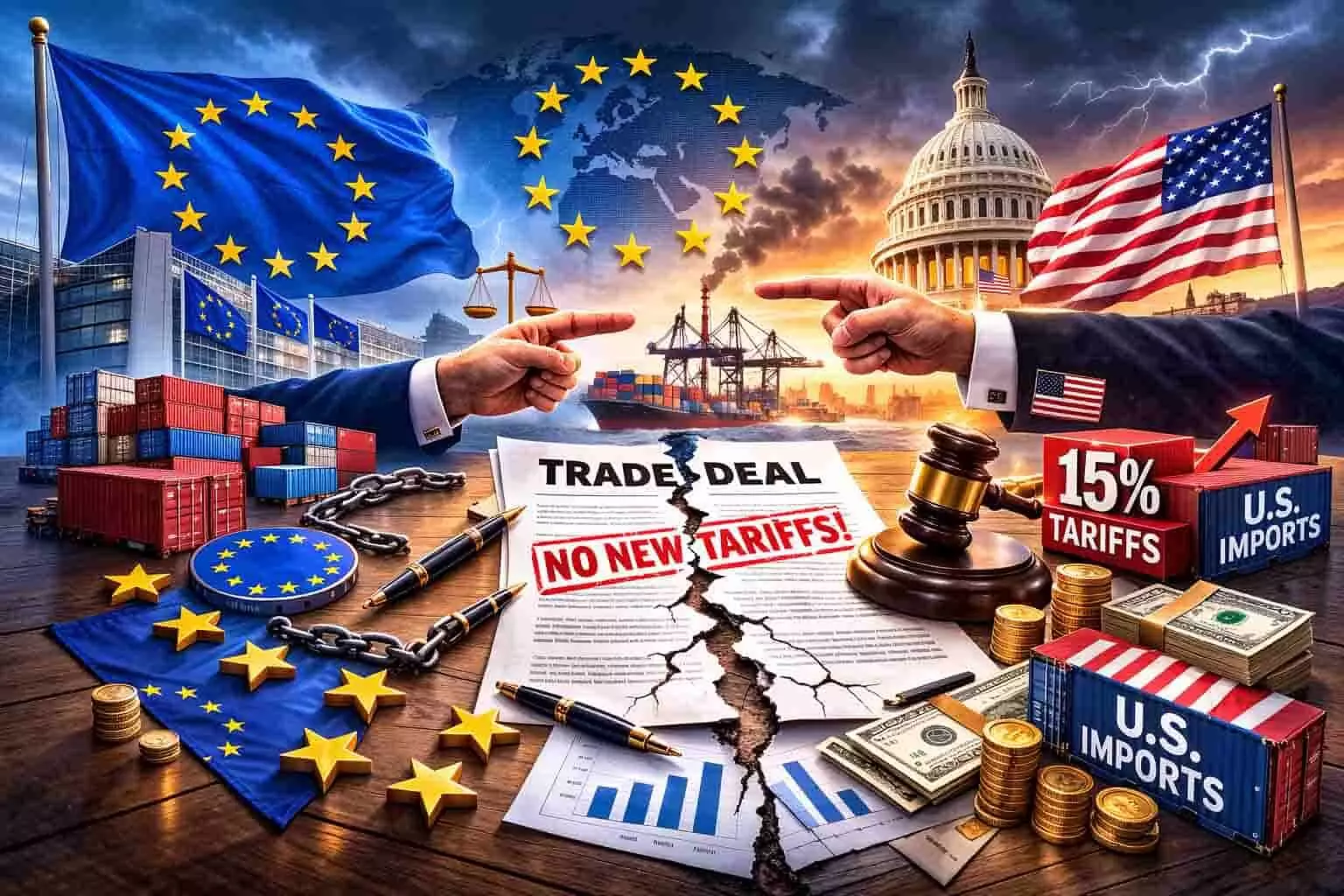
Transatlantic trade tensions escalated after the European Union insisted that the United States must honor the terms of last year’s EU-U.S. trade agreement, following a U.S. Supreme Court decision that invalidated earlier global tariffs and the subsequent announcement of new levies. Brussels made clear that it would accept no increase in tariffs beyond the ceiling agreed in the bilateral deal, stating firmly that “a deal is a deal.”
Why This Matters
The dispute risks undermining the stability of transatlantic trade, which represents one of the world’s largest economic partnerships.
Supreme Court Ruling Triggers Policy Shift
The controversy follows a landmark U.S. Supreme Court decision that struck down a previous round of global tariffs. In response, the U.S. administration announced temporary, across-the-board tariffs of 10%, which were then raised to 15% a day later. The move has prompted renewed concern among trade partners, particularly in Brussels.
The European Commission, which negotiates trade policy for the bloc’s 27 member states, called on Washington to provide “full clarity” regarding how it intends to proceed after the judicial ruling. EU officials signaled that unpredictability in tariff policy could disrupt supply chains and investment flows.
What the EU-U.S. Trade Deal Stipulates
The transatlantic trade agreement reached last year set a 15% tariff rate for most EU goods entering the United States, excluding certain sectors such as steel, which remain subject to separate measures. It also provided zero-tariff treatment for selected industries, including aircraft and related components.
In exchange, the EU removed import duties on various American products and stepped back from potential retaliatory measures. The understanding was presented as a balanced compromise aimed at stabilizing trade relations after years of tariff disputes.
Brussels’ Stronger Tone
The European Commission’s latest statement marked a notable escalation in tone compared with its initial reaction, when officials said only that they were reviewing the Supreme Court decision and maintaining dialogue with Washington.
Now, EU officials have emphasized that European goods must continue to receive “the most competitive treatment,” without any tariff increases beyond the clearly agreed ceiling. The Commission warned that unpredictable tariff adjustments undermine business confidence and destabilize global markets.
Diplomatic Engagement Continues
EU Trade Commissioner Maros Sefcovic has already discussed the matter with U.S. Trade Representative Jamieson Greer and Commerce Secretary Howard Lutnick. These talks are viewed as crucial to preventing further escalation.
Both sides have significant economic incentives to avoid a breakdown. The EU and the United States maintain one of the largest trade and investment relationships globally, encompassing goods, services, and cross-border capital flows worth hundreds of billions of dollars annually.
Market and Business Implications
Financial markets are closely monitoring developments. Tariff uncertainty can create volatility in currency markets, commodity prices, and equities, particularly in sectors exposed to cross-border trade such as manufacturing, aerospace, and agriculture.
Industry groups on both sides of the Atlantic have previously warned that abrupt tariff changes complicate supply planning and increase operational costs. Businesses rely heavily on predictability when making long-term investment decisions.
Broader Geopolitical Context
The dispute unfolds amid broader geopolitical and economic tensions. Trade policy remains intertwined with domestic political considerations and global strategic positioning. Observers note that the durability of transatlantic economic ties depends not only on legal agreements but also on sustained political commitment.
The EU’s insistence that the previously agreed ceiling must remain intact reflects a broader principle in international trade: stability and rule-based systems are foundational to global commerce.

Transatlantic Trade Snapshot
- Supreme Court voided earlier global tariffs
- U.S. imposed temporary 10%, then 15% levies
- EU demands adherence to agreed ceiling
- Diplomatic talks underway
EU urges the United States to respect last year’s trade agreement following new tariff measures.
Frequently Asked Questions
Why is the EU objecting to new U.S. tariffs?
The EU argues that the previously agreed 15% tariff ceiling must not be exceeded and that any changes violate the terms of the bilateral deal.
What triggered the new tariffs?
The U.S. administration introduced temporary tariffs after the Supreme Court invalidated earlier global measures.
Does the existing trade deal allow tariff increases?
The agreement established a defined ceiling for most goods, which the EU says must remain intact.
Could this escalate into a trade dispute?
While tensions have risen, diplomatic engagement is ongoing to avoid further escalation.
How might markets react?
Uncertainty in tariff policy can increase volatility in global financial markets and disrupt supply chains.

Aaryan Puneet Dwivedi
Aaryan Puneet Dwivedi is a senior editor and an experienced journalist who has been active in the news industry since 2013. He has extensive experience covering and editing news across multiple fields, including politics, national and international affairs, sports, technology, business, and social issues. He is a state-level accredited journalist recognized by the Madhya Pradesh government. Known for his in-depth understanding of news and current affairs, he focuses on delivering accurate, reliable, and reader-friendly information across all major news categories.